

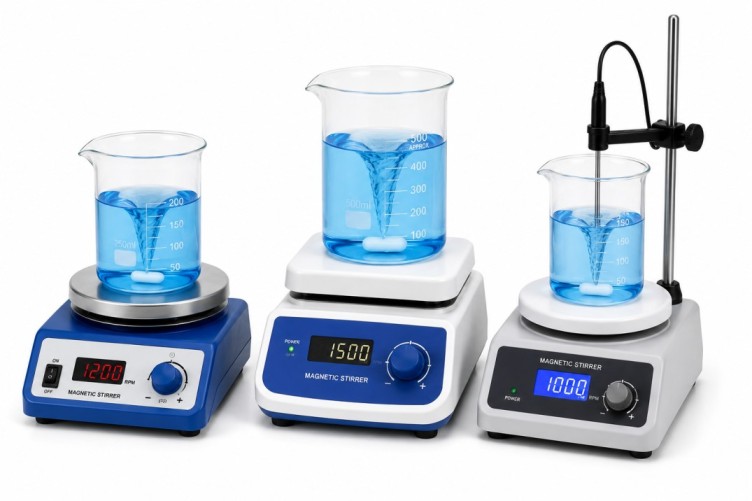
Improving Solution Homogeneity, Reagent Preparation and Controlled Mixing in Scientific Work
Reliable laboratory results often depend on how thoroughly and consistently liquids are mixed. Magnetic Stirrers offer a practical way to create continuous agitation in solutions without the need for manual stirring. By using a rotating magnetic field to move a stir bar inside the vessel, these instruments support repeatable mixing for chemistry, analytical testing, pharmaceutical research and many routine laboratory procedures.
Their value lies in maintaining steady movement over time. This can be especially useful when a reagent needs to dissolve gradually, when a solution must remain uniform during preparation or when researchers want to reduce variation between different batches.
Why Does Consistent Mixing Matter?
A laboratory solution may appear uniform even when concentration differences remain within the vessel. Poor mixing can leave undissolved material at the bottom, create localised concentration gradients or produce inconsistent samples.
Continuous stirring helps distribute material throughout the liquid and supports more even conditions.
This is important during procedures such as buffer preparation, chemical dissolution, formulation work and reagent mixing. A consistent mixing method can also reduce dependence on manual technique, helping different operators achieve more comparable results.
The required stirring intensity depends on the liquid itself. Low-viscosity solutions may need only moderate agitation, while thicker liquids may require greater mixing energy.
How Is Magnetic Stirring Different From Other Mixing Methods?
Magnetic stirring uses a stir bar inside the vessel rather than a mechanical shaft entering the liquid from above.
This design can simplify setup and reduce the amount of external equipment around the vessel.
Other laboratory Stirrers may be more appropriate when working with larger volumes, highly viscous materials or applications requiring greater mechanical force.
The best mixing method depends on the application. Magnetic systems are often well suited to routine liquid preparation, while other stirrer designs may provide advantages for heavier or more demanding mixtures.
Understanding these differences helps laboratories choose equipment based on actual mixing requirements rather than using one approach for every procedure.
Why Is Stir-Bar Selection Important?
The stir bar is the component that physically moves the liquid, so its size and shape can influence mixing performance.
A stir bar that is too small may not generate sufficient circulation. One that is too large may become unstable, especially when operated at higher speeds.
Researchers should consider vessel diameter, liquid depth, viscosity and required mixing intensity.
The goal is to achieve smooth rotation without repeated loss of magnetic coupling.
If the stir bar begins to jump or rotate irregularly, lowering the speed and checking the vessel position can often help restore stable operation.
Supporting Everyday Mixing With Suitable Accessories
Routine laboratory mixing often involves more than the stirrer itself.
Wipers And Stirrers can support practical laboratory handling where stirring components and related accessories are required during preparation and processing.
Keeping suitable accessories available helps researchers prepare the mixing setup efficiently and maintain cleaner working practices.
Stir bars and reusable components should be cleaned between procedures where necessary, particularly when changing between chemically different reagents or samples.
Residues from an earlier experiment can alter a later mixture, so good cleaning practices support both equipment performance and sample integrity.
When Is Heating Useful During Magnetic Stirring?
Some materials dissolve more readily when gentle or controlled heating is combined with agitation.
A Magnetic Stirrer With Hotplate combines mixing and heating functions in a single laboratory setup.
This can be useful during solution preparation where temperature influences dissolution rate, viscosity or reaction behaviour.
Heating should still be selected carefully. Excessive temperature may affect heat-sensitive compounds, increase solvent evaporation or change chemical properties.
Researchers should consider the required temperature together with stirring speed rather than adjusting either factor independently.
A stable combination of heat and movement can provide more controlled preparation conditions.
How Do Magnetic Stirrers Support Buffer Preparation?
Buffers are commonly prepared in laboratories because they help maintain defined chemical conditions during experiments.
Special Buffer Solutions may be used in analytical and scientific workflows where controlled solution properties are important.
During buffer preparation, magnetic stirring can help dissolve components evenly before final adjustment.
A typical workflow may involve adding solvent to a vessel, introducing measured components gradually and stirring until the mixture becomes homogeneous.
If the procedure includes pH or volume adjustment, the solution should remain adequately mixed so that measurements reflect the entire mixture rather than one local region.
How Can Researchers Improve Mixing Performance?
Good stirring depends on the complete setup rather than on speed alone.
Important factors include:
- Matching the stir bar to the vessel
- Keeping the vessel centred on the stirring platform
- Selecting a suitable liquid volume
- Increasing speed gradually
- Avoiding an unnecessarily deep vortex
- Monitoring temperature when heat is used
Excessive speed can introduce air into the liquid or create splashing. Very low speed may fail to move material effectively.
Finding a stable operating point usually provides better results than simply using the highest available setting.
Common Problems During Magnetic Stirring
One common issue is loss of magnetic coupling, sometimes called stir-bar decoupling. This happens when the bar can no longer follow the rotating magnetic field smoothly.
It may occur when speed is increased too quickly, the bar is poorly matched to the vessel or the liquid is too viscous for the setup.
Uneven vessel placement can also affect performance.
Another issue is incomplete dissolution. If solid material remains on the bottom or walls, researchers may need to adjust the stirring speed, liquid volume or addition method.
Monitoring the mixture throughout preparation helps identify these problems early.
Selecting a Magnetic Stirrer for Laboratory Use
Choosing the right instrument depends on the intended workflow.
Laboratories should consider expected vessel size, sample volume, viscosity, required speed range and whether heating is necessary.
Available bench space also matters, particularly in laboratories where several instruments are used at the same workstation.
The most suitable magnetic stirrer is not necessarily the most complex model. It is the one that provides stable and controllable mixing for the laboratory’s typical applications.
Building More Reproducible Mixing Workflows
Magnetic stirrers remain important laboratory tools because they offer a simple and repeatable way to maintain liquid movement during preparation and experimentation.
Their performance can be improved by selecting suitable stir bars, matching the system to the liquid and vessel, controlling speed carefully and adding heat only when the procedure requires it.
When combined with suitable laboratory accessories and well-defined operating conditions, magnetic stirring can support more uniform solutions, cleaner workflows and greater consistency across repeated scientific procedures.
